Types of Craniosynostosis: Meaning and Characteristics of Types
Early fusion of a baby’s skull could be detected by parents if the baby’s head shape, forehead position or facial symmetry changed. This is known as craniosynostosis. This occurs when one or more of the skull sutures – the flexible joints that connect the bones of the skull – fuse before the brain is fully developed.
For many families, the first clue is an oddly shaped skull noticed at birth or in the first months of life. Some changes are small. Others are easier to spot, such as a long, narrow head, a flattened forehead, uneven eyes or flattening at the back of the head.
If you are searching for types of craniosynostosis explained in simple, reassuring language, knowing about the main forms can help you know what to look for, what questions to ask, and when to seek specialized care.
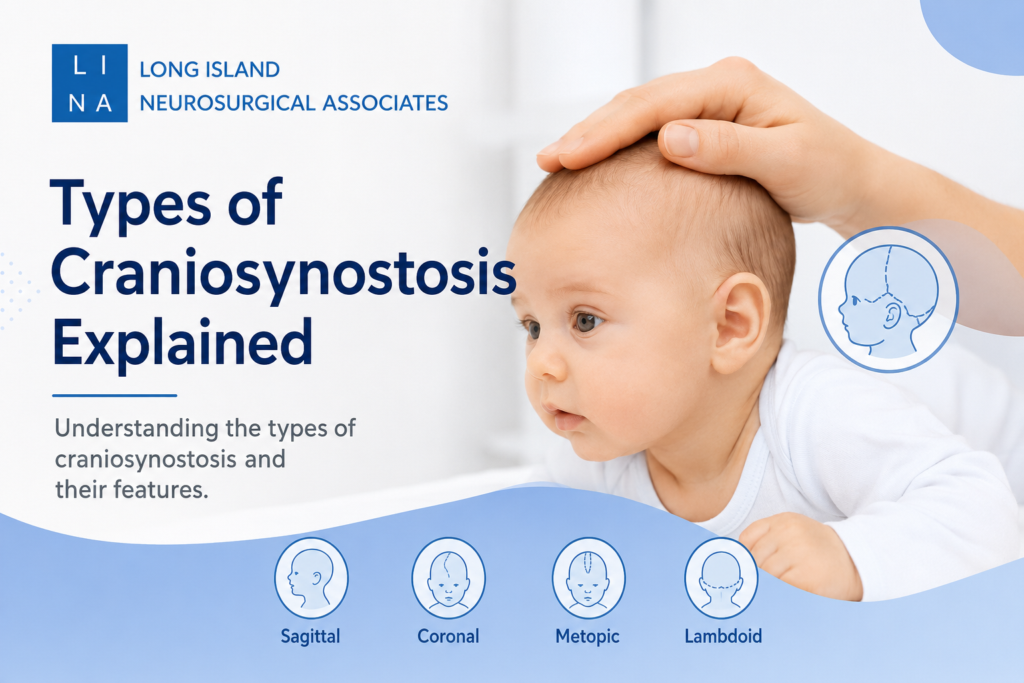
The four main types most often discussed by the suture involved are sagittal, coronal, metopic, and lambdoid. Some children have single-suture craniosynostosis, some have multiple sutures involved, which may represent a more complex condition.
At Long Island Neurosurgical Associates (LINA), families find a child-centered approach to neurosurgery, with direct communication, personalized craniosynostosis treatment planning and support before, during and after care. We are a part of Cohen Children’s Medical Center and Northwell Health, serving patients across Long Island, New Hyde Park, Staten Island, Manhattan and Smithtown. If you have concerns regarding your child’s head shape, a pediatric neurosurgical evaluation will help determine if craniosynostosis is present, and what steps may be right for your child.
What is Craniosynostosis and Why Early Assessment is Important
A baby’s skull consists of several bones separated by flexible sutures. These sutures allow the skull to grow as the brain grows. In craniosynostosis one or more sutures close prematurely. If growth is limited in one direction, the skull may grow differently in another direction. This results in the head shape pattern associated with the fused suture.
Craniosynostosis may be obvious soon after birth, or it may become more obvious over time. Parents may notice that the head doesn’t look round, that one side looks different from the other or that a ridge can be felt along part of the skull. Sometimes, the forehead, eyes, ears, or back of the head may appear uneven in some children.
The skull grows rapidly in infancy, so early evaluation is important. Early diagnosis can assist the care team in monitoring brain development, evaluating pressure inside the head, and deciding whether surgery or observation is needed. Not every child’s needs are the same. Age, involvement of sutures, head shape, symptoms and general health all influence the care plan.
Parents should see a specialist if they notice:
- A head that looks long, narrow, flat, triangular or irregular
- Prominent ridge on the skull
- A forehead that looks flattened, bulging or uneven
- Uneven and/or asymmetrical eyes or ears
- Abnormal or slow growth of the head
- Concerns about feeding, irritability, development or vision
Not all head shape concerns are craniosynostosis. Many babies have flat spots from sleep position. A specialist can make all the difference and give families the confidence to move forward.
Types and Features of Craniosynostosis
The main types are named after the suture that closes too early. Each pattern changes the shape of the head differently. Some types are more common than others and some are more likely to be associated with a syndrome or other medical needs.
Type | Suture Involved | Head Shape Features | What Parents May See |
Sagittal Craniosynostosis | Sagittal Suture at the Top of the Head | Long, narrow head (scaphocephaly) | Large forehead or occiput, ridge along top of skull |
Coronal Synostosis | One or both coronal sutures at the front of the skull | Flattened side of forehead, facial asymmetry or short/wide head if both sides involved | Uneven brow or eye position, forehead asymmetry |
Metopic Craniosynostosis | Metopic suture from top of head to nose | Forehead is triangular (trigonocephaly) | Narrow forehead, eyes close together, ridge down the middle of the forehead |
Lambdoid Craniosynostosis | Lambdoid suture in back of head | Flat or sloping back of the skull | Changes in the position of the ears, asymmetry of back of head |
Multisuture Synostosis | Two or more sutures | More complex skull shape change | May include increased pressure risk, syndrome assessment and co-ordinated care |
In some children, craniosynostosis is nonsyndromic, which means that it occurs without a related genetic syndrome. This is seen with a single fused suture. Some children have syndromic craniosynostosis that may be associated with genetic syndromes and can affect the face, hands, feet, airway, eyes or other parts of the body.
Secondary craniosynostosis is less common and can occur due to a medical condition that affects the growth of the skull and/or brain. Craniosynostosis can be caused by many things, and it is important to get an accurate diagnosis before deciding on a course of treatment.
Sagittal Craniosynostosis, Scaphocephaly and What Can Be Done
The most common type of craniosynostosis is sagittal craniosynostosis. It happens when the sagittal suture, the line that runs from front to back along the top of the head, fuses prematurely. This limits the side to side growth and makes the head grow longer front to back. The medical name for this shape of the head is scaphocephaly.
Parents may observe that the child’s head looks long and narrow. The forehead might look more prominent and the back of the head might be more noticeable too. You may be able to feel a firm ridge along the top of the head where the suture has fused.
Evaluation is intended to understand the degree of fusion, the child’s age, skull growth and signs that the condition may affect health or development. A detailed physical examination and measurements of the head, with imaging as needed.
Treatment varies with the child. Depending on age, diagnosis, head shape, and specialist evaluation, some infants may be candidates for different surgical approaches. Surgery can sometimes help to free the fused bones, improve skull growth and create a more balanced head shape. Follow-up allows the team to follow healing, development and progress over time.
Our approach at LINA for the whole family. Parents receive clear explanations, time to ask questions and guidance on what to expect if surgery is advised. Our goal is not simply to treat the fused suture, but to assist each child to progress with caring, individualized attention.
Forehead Deformities: Coronal Synostosis and Metopic Synostosis
Coronal synostosis involves one or both coronal sutures. These are located near the front of the skull, from ear to ear. If one side closes early the forehead on that side may appear flattened. The other side may appear to be fuller. The brow or eye socket may also appear uneven, which could make the asymmetry of the face more noticeable.
Early closure of the coronal sutures can make the head appear shorter from front to back and broader from side to side. When there is bilateral coronal involvement, the suspicion for syndromic craniosynostosis increases, particularly when other features are present.
Metopic craniosynostosis involves the suture that runs down the middle of the forehead toward the nose from the top of the head. Infants can have triangular-shaped forehead as a result of metopic fusion. Some have a visible ridge in the middle of the forehead that tapers at the temples, or eyes that appear to be close together.
Not every ridge requires surgery. Some is mild severity metopic ridging. A specialist can tell if the forehead shape is a true craniosynostosis and if the child needs to be monitored or treated.
Care planning may include for both coronal and metopic forms:
- Physical examination and head measurements, growth history review
- Imaging to confirm which suture has fused if necessary
- Checking vision, development or signs of pressure
- Discuss when you will have the operation and how long it will take to recover if treatment is recommended
- Continued follow-up as the child grows
If there are changes to the forehead, eyes or face, families often get anxious. Clear guidance helps to reduce the uncertainty. LINA works with parents to explain the findings, review treatment options and develop a plan that supports both health and appearance.
Complex Cases, Positional Flattening and Lambdoid Craniosynostosis
Lambdoid craniosynostosis is uncommon. This occurs when one or both lambdoid sutures at the rear of the skull close prematurely. It can be confused with positional plagiocephaly, which is flattening of the back of the head due to repeated pressure on one part of the skull.
It makes a difference. The flattening is positional and not caused by fused skull bones. Lambdoid craniosynostosis does. There are signs that help to tell these apart, such as the shape of the head, the position of the ears, and the angle of the base of the skull. A specialist can look for these signs.
Lambdoid craniosynostosis may cause flattening or slanting at the back of the head in babies. The ear on the affected side may be positioned differently. The base of the skull may look tilted. The pattern is often different in positional plagiocephaly. Treatment for positional plagiocephaly may include repositioning, physical therapy, or helmet therapy, not craniosynostosis surgery.
Expert opinion is especially helpful because lambdoid fusion is rare. If surgery is required, the aim is to release the fused area, to improve symmetry, and to allow normal skull growth. Even if surgery is not necessary, families benefit from a definitive diagnosis and a plan for follow-up.
Multisuture synostosis is the premature fusion of two or more sutures of the skull. These cases might have a higher risk of increased pressure inside the head and can lead to more complex changes in skull shape. Some children with multisuture involvement have syndromic craniosynostosis and some do not.
Syndromic forms may be associated with conditions such as Apert, Crouzon, Pfeiffer or other craniofacial syndromes. Over time, these children may need to be seen by a number of specialists. Depending on the syndrome, treatment may include the skull, face, airway, eyes, hearing, dental development, hands, feet, developmental support.
Syndromic and multisuture cases require careful planning. The care team may discuss whether to perform the surgery in stages, how to monitor brain development and which specialists should be on the team. Some families may be offered genetic counseling or genetic testing.
At LINA, families will experience a collaborative approach that values parent insight, clear communication and coordinated pediatric neurosurgical care. We work with the specialists at Cohen Children’s Medical Center to provide your child with the complete, integrated care they need at each phase of treatment.
When to Call LINA to Evaluate for Craniosynostosis
Parents are often the first to see something that looks different. Trust your instinct. While concern for head shape does not always mean surgery is needed, when craniosynostosis is a possibility it warrants careful evaluation.
If your baby has an abnormal head shape, a visible ridge on the skull, asymmetry of the forehead, uneven eyes or ears, or a diagnosis that requires a pediatric neurosurgery opinion, contact Long Island Neurosurgical Associates. LINA provides pediatric neurosurgical care emphasizing accurate diagnosis, individualized treatment and family support.
Serving families throughout New Hyde Park, Long Island, Staten Island, Manhattan, and Smithtown, NY. We are honored to serve as the Pediatric Neurosurgery Division for Cohen Children’s Medical Center of Northwell Health.
Getting early advice can make the subsequent steps less daunting. Whether your child needs monitoring, imaging, surgery or a second opinion, our team will walk you through the process with compassion and direct communication.
Meet with Long Island Neurosurgical Associates to learn more about your child’s skull growth, treatment options and what lies ahead.