
Congenital Spine Disorders: Expert Treatment Options in New York
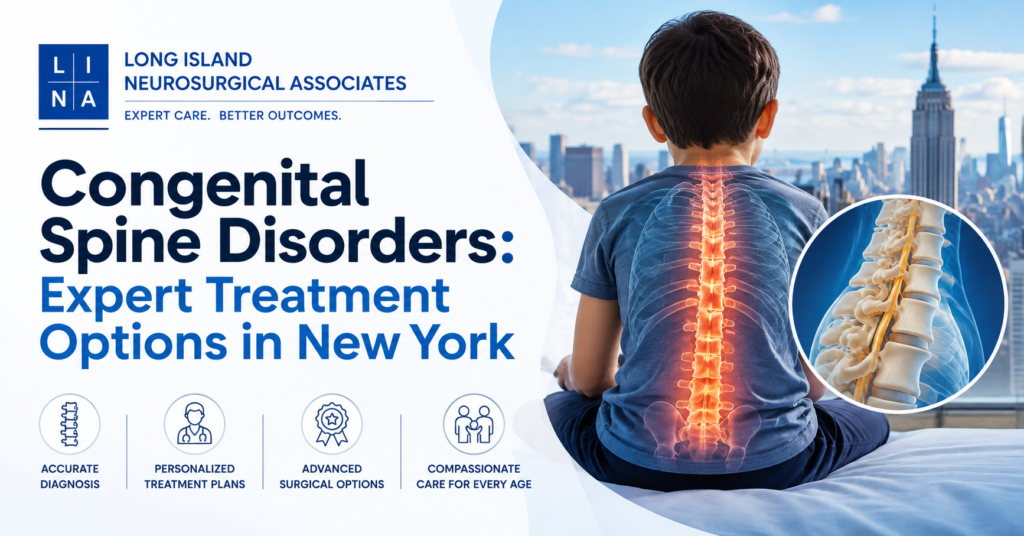
If you or your child has been told there is a congenital spine disease or an abnormality of the spine that has been present since birth, you likely have many questions about what it means, how it may change over time, and what to do next. Patients seeking congenital spine disorders treatment in New York can turn to Long Island Neurosurgical Associates (LINA) for careful evaluation and treatment planning for patients of all ages.
Congenital and developmental spine disorders are structural differences of the spine, spinal cord, or surrounding tissues that form before birth. Some are found on a prenatal ultrasound or shortly after delivery, while others are not recognized until childhood, adolescence, or even adulthood.
Our team helps patients and families understand what type of condition is present, whether it needs treatment, and how to plan for the future. Depending on the condition, care may involve monitoring over time, non-surgical support, or surgery to protect the spinal cord and nerves.
What Are Congenital Spine Disorders?
Congenital spine disorders are conditions in which part of the spine, spinal cord, or nerve tissue does not develop in the usual way before birth. They can affect the bones of the spine (the vertebrae), the spinal cord and its coverings, or the way the spinal cord sits within the spinal canal.
Common examples include spina bifida, tethered cord syndrome, hemivertebrae (a vertebra that forms only partly), fused or misshapen vertebrae, and Klippel-Feil syndrome. Some of these conditions can lead to curvature of the spine, and children with them may also be evaluated for scoliosis. You can read more in our guide to scoliosis and spinal deformity treatment.
Many congenital spine conditions are mild and cause no problems, while others can affect walking, bladder and bowel control, posture, or growth. Because the spine continues to grow through childhood, a condition that was stable early on may need closer attention during growth spurts.
Signs and Symptoms to Look For
Signs vary widely depending on the specific condition and the age of the patient. Signs that families and adults should discuss with a specialist include:
- A dimple, tuft of hair, birthmark, or fatty lump on the lower back
- A visible curve of the spine, uneven shoulders, or uneven hips
- Back pain that is new, worsening, or limits activity
- Weakness, numbness, or changes in how a child walks
- Foot deformities or differences in leg length or size
- Changes in bladder or bowel control, including new accidents after toilet training
- A short neck or limited neck movement
Some patients are diagnosed after an MRI or X-ray ordered for another reason. An unexpected finding on imaging is a good reason to seek an opinion from a specialist who treats these conditions regularly.
Families also come to Long Island Neurosurgical Associates for second opinions. If you have already received a diagnosis and want to better understand whether surgery is needed, how soon, and what recovery looks like, our team can walk you through the next steps.
Evaluation and Diagnosis
A complete neurological and physical exam starts every evaluation. The specialist checks strength, sensation, reflexes, walking, posture, and the skin over the spine, and reviews the patient’s birth, growth, and developmental history.
Imaging is central to diagnosis. X-rays show the shape and alignment of the vertebrae, while an MRI shows the spinal cord, nerves, and surrounding tissue in detail and is often the most useful study for conditions such as tethered cord. A CT scan may be added to look closely at the bones. Some patients also need bladder function testing.
At the end of the visit, patients and families should know what condition is present, whether it is likely to change, and what the plan is, including whether observation is appropriate.
Treatment Options for Patients
Not every patient is treated the same way. The treatment plan is based on:
- The specific type of congenital condition and where it is in the spine
- Whether the spinal cord or nerves are stretched, compressed, or at risk
- The presence of symptoms such as weakness, pain, or bladder and bowel changes
- The patient’s age and remaining growth
- Whether the spine is curving or the condition is progressing over time
Many congenital spine findings that cause no symptoms are simply monitored with periodic exams and imaging. Surgery is generally considered when there is a risk to the spinal cord or nerves, symptoms are developing or worsening, or a spinal curve is progressing.
| Treatment Path | When It May Be Considered | What Patients Should Know |
|---|---|---|
| Observation and periodic imaging | Findings without symptoms, or stable conditions | Regular follow-up tracks whether anything is changing as the child grows. |
| Bracing or physical therapy | Some spinal curves and posture-related symptoms | Supports comfort and function, and may slow progression of certain curves in growing children. |
| Surgery to release a tethered spinal cord | A cord that is stretched or tethered, especially with symptoms | The goal is to free the cord and protect or improve nerve function. |
| Surgery to correct or stabilize the spine | Progressive curves or unstable spinal segments | Instrumentation may be used to correct alignment and support the spine. |
| Long-term follow-up | Most patients, including those who have had surgery | Care often continues through growth and into adulthood, sometimes with urology or rehabilitation teams. |
Surgery for Congenital Spine Conditions
When surgery is recommended, the goal is to protect the spinal cord and nerves, relieve tension or pressure, and keep the spine stable and well aligned. For a tethered spinal cord, surgery releases the tissue holding the cord in place. For curves caused by an abnormal vertebra, surgery may correct the curve and support the spine as the child grows.
Families often ask about the hospital stay, pain control, activity limits, and how long recovery takes. The team at Long Island Neurosurgical Associates makes sure patients and families are informed before surgery, during the hospital stay, and throughout recovery. Children are also evaluated through our pediatric congenital brain and spinal malformations program, and some conditions overlap with brain-stem conditions such as a Chiari malformation.
Recovery varies with the procedure and the patient. Follow-up visits allow the team to monitor healing, nerve function, and growth over time.
Frequently Asked Questions
What Is a Congenital Spine Disease?
It is a structural difference in the spine, spinal cord, or nearby tissue that develops before birth. The range is wide, from minor findings that never cause problems to conditions that need surgery.
Can Congenital Spine Disorders Be Found in Adults?
Yes. Some conditions are mild enough to go unnoticed until adulthood, when back pain, nerve symptoms, or an imaging study done for another reason brings them to light.
Does Every Congenital Spine Condition Need Surgery?
No. Many are monitored over time. Surgery is typically recommended when there is a risk to the spinal cord or nerves, symptoms are progressing, or a curve is getting worse.
What Is a Tethered Spinal Cord?
It occurs when tissue holds the spinal cord in place so it cannot move freely as the child grows, which can stretch the cord and cause pain, weakness, or bladder and bowel changes.
Is Treatment Covered by Insurance?
Coverage depends on your plan, diagnosis, and whether a referral is needed. Our team can help you understand what authorizations and documentation are required.
How Do I Book a Consultation?
Make an appointment online or call Long Island Neurosurgical Associates to discuss your or your child’s diagnosis, symptoms, and preferred office location.
Schedule a Consultation for Congenital Spine Disorders Treatment in New York
If you or your child has been diagnosed with a congenital spine condition, or you would like a second opinion, contact Long Island Neurosurgical Associates to schedule a complete evaluation. You can also learn more about our pediatric neurosurgery and adult neurosurgery services.
Call today to make an appointment with a neurosurgical specialist and receive clear next steps for your care.